Hack The Box Enterprise has become one of the most powerful ecosystems for cybersecurity skill development: hands-on labs, advanced challenges, role-based Academy paths, and structured environments designed for real-world problem solving. For modern cybersecurity teams, it’s an environment with enormous potential, but one that requires structure, alignment, and sustained guidance to turn that potential into measurable capability. And that’s where Cyber Helmets comes in.
Using the HTB Enterprise ecosystem as the core engine for hands-on growth, Cyber Helmets provides the strategic layer organizations need: structured development plans, curated learning paths, continuous monitoring, expert-led deep dives, and the ability to measure progress over time. This isn’t training for the sake of training, it’s a capability-building program.
Teams gain four essential layers of support that sit on top of their HTB subscription: structured training plans, curated content, visibility into performance, and expert-led workshops.
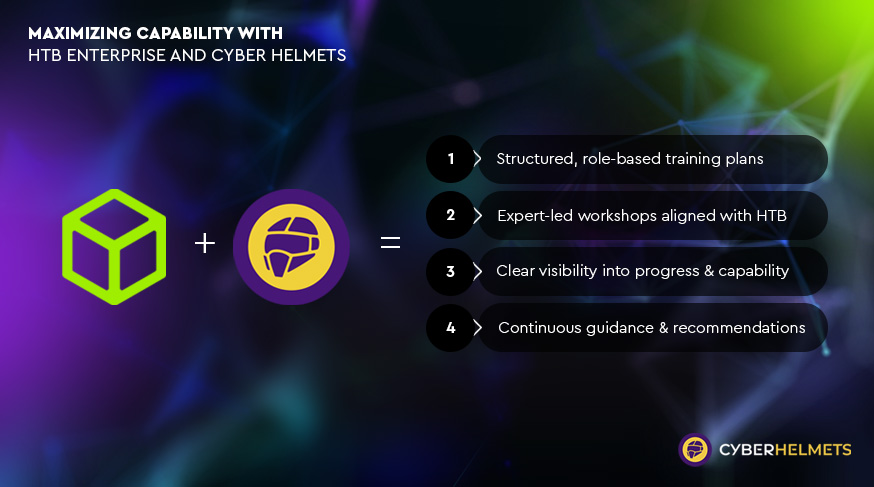
How Cyber Helmets extends the value of HTB Enterprise.
Below is a breakdown of how these components come together, why they matter, and how they help organizations extract the maximum value from their HTB investment.
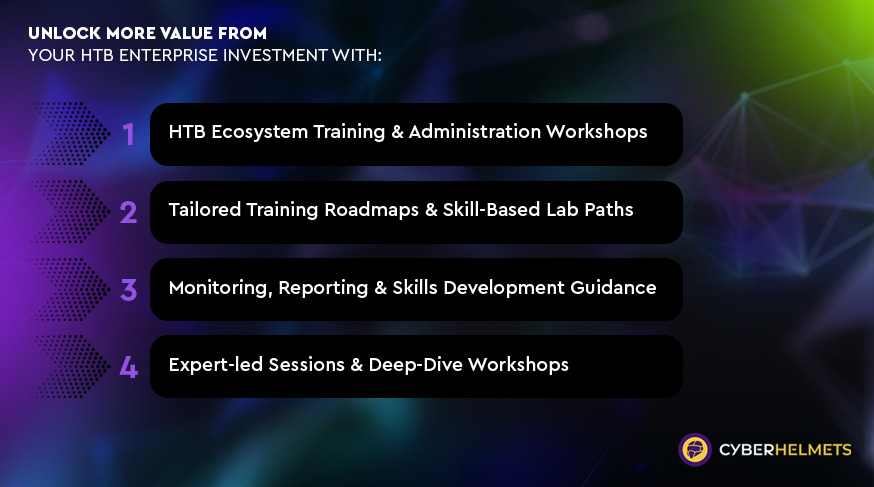
1. HTB Ecosystem Training & Administration Workshops
Helping teams actually use, manage, and operationalize HTB Enterprise.
The first barrier many organizations encounter is simply learning to use HTB effectively. The platform is rich and expansive, Labs, Academy, Battlegrounds, Challenges, CTFs, and it requires proper onboarding, administration, and workflow integration. Cyber Helmets delivers hands-on workshops that teach administrators and team leads how to:
➜ Provision and manage training environments
➜ Track performance and issue challenges
➜ Create internal competitions to increase engagement
➜ Integrate HTB into existing internal workflows
This step ensures teams don’t just access the ecosystem, they know how to extract value from it. It removes friction, reduces internal admin time, and builds the foundation for capability growth.
2. Tailored Training Roadmaps & Skill-based Lab Paths
Turning a massive content library into a personalized learning journey.
HTB’s volume of content is one of its strengths but also one of the reasons teams get stuck. Instead of navigating hundreds of labs on their own, Cyber Helmets designs structured paths built around:
➜ Job roles (SOC, Red Team, Blue Team, DevSecOps, Cloud, etc.)
➜ Current skill levels
➜ Learning goals and expected outcomes
➜ Available time per week/month
This includes curated lists of labs, recommended Academy modules, and clear progression paths from beginner → intermediate → advanced
In other words no more guesswork. Each person gets the right challenge at the right time.
This model boosts engagement, improves skill retention, and links daily training activity to real organizational objectives.
3. Monitoring, Reporting & Skills Development Guidance
Visibility into progress, gaps, strengths, and capability growth.
Most training programs fail because there’s no way to measure progress beyond “hours spent.” Cyber Helmets changes that by providing structured, periodic reporting that shows:
➜ Individual and team performance across labs and assessments
➜ Strengths, emerging skills, and gaps
➜ Training stagnation alerts
➜ Recommendations for next steps, new labs, or targeted guidance
These insights turn training into a continuous, data-driven development program rather than a one-off activity.
For leaders, this solves a major problem: You finally know what your people are learning, how well they are progressing, and where intervention is needed.
For teams: It provides direction, accountability, and motivation.
4. Expert-led Sessions & Deep-Dive Workshops
Real experts. Real scenarios. Real skill-building.
This is where classroom learning meets field experience. Cyber Helmets instructors deliver specialized sessions built around the organization’s specific needs and synced with each trainee’s HTB progress. Topics include:
➜ Penetration testing fundamentals and advanced techniques
➜ Adversarial mindset & red team methodology
➜ Cloud security across AWS, Azure, and GCP
➜ AI-powered attacks & defenses
➜ Windows/Linux exploitation
➜ Incident response & threat hunting
These sessions turn theory into action, something most cybersecurity teams desperately lack. They also ensure that training is not isolated to labs but contextualized into real-world operational scenarios.
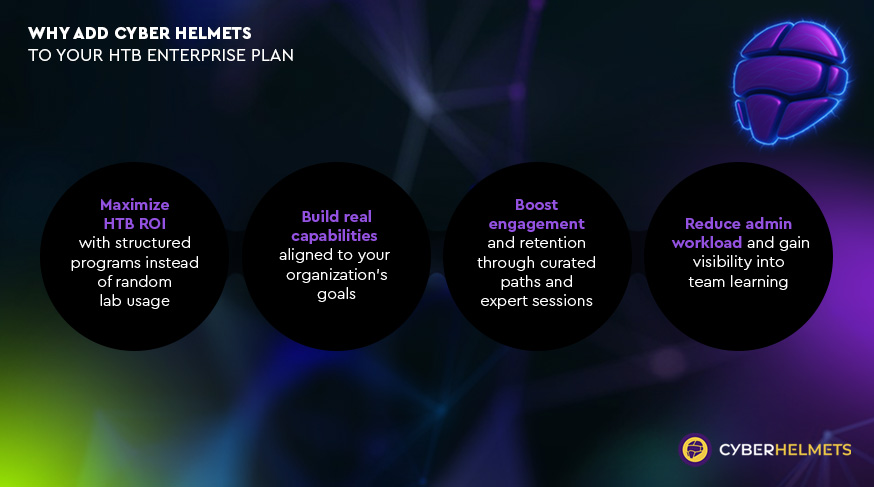
Why Teams Add Cyber Helmets to HTB Enterprise
➜ 1. Maximize ROI
Structured programs ensure your HTB investment translates into actual capability.
➜ 2. Build real, aligned capabilities
Training maps directly to organizational goals and job roles.
➜ 3. Reduce internal administration time
Your team no longer needs to manage training logistics.
➜ 4. Boost engagement and retention
Curated paths and expert sessions keep people motivated.
➜ 5. Gain visibility into skills and progress
Finally understand who is learning what and how well.
Together, these create a training ecosystem that is purposeful, measurable, and operationally relevant.
Deepen your HTB Enterprise strategy
If you’re evaluating ways to bring more structure and visibility into your HTB Enterprise training, book a meeting with us to discuss how this approach could work for your team.